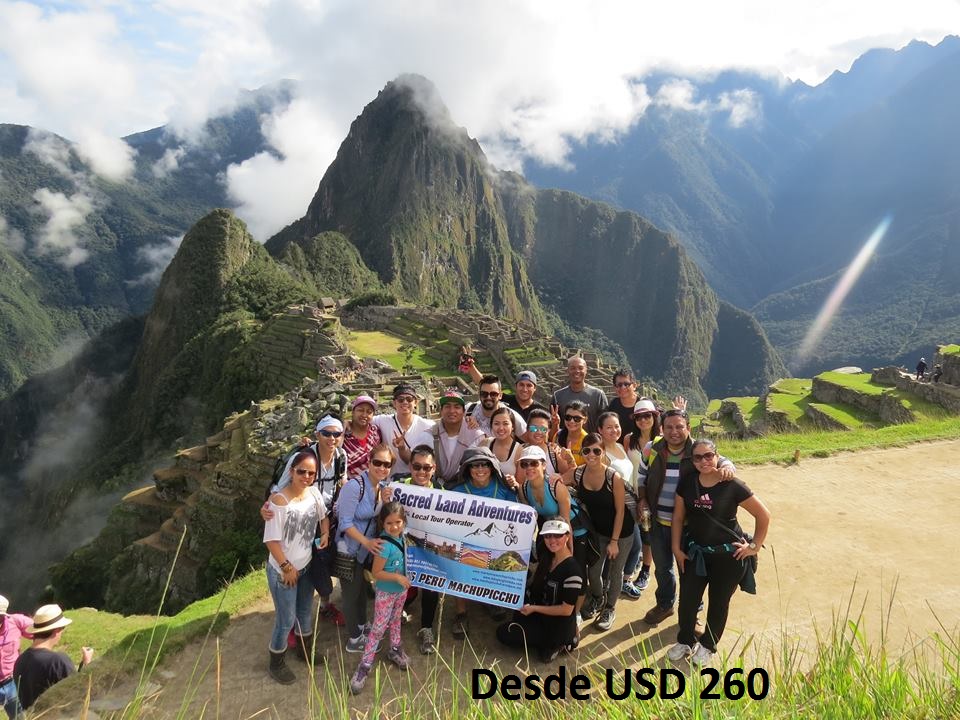
Tour Sacred Valley of the Incas 1 day
Tour Sacred Valley of the Incas 1 day
Tours through the Sacred Valley of the Incas This tour is recommended because it is unique. Throughout the circuit you can appreciate majestic and wonderful fertile landscapes with its meandering sacred river “Vilcanota” visit the artisan markets and guided visits to the 3 most important archaeological centers of the Sacred Valley of the Incas located in Cusco Peru offered in Machu Picchu tour.
The Sacred Valley of the Incas is located 27 km (1 h) NE of Cusco for one paved road in good condition. This sacred valley extends along a Vilcanota river (the same one that downstream takes the name of Urubamba or Willcamayu). It covers the area between the towns of Písac and Ollantaytambo. It is possible to access it through three paved roads to the Sacred Valley of the Incas. A succession of picturesque villages (some with splendid colonial churches), terraces and other Inca archaeological remains, yes as wide fields where excellent corn is grown and an exceptional climate, make this valley a must-see destination for everyone who visits Cusco. Among the tourist activities of the tour that can be developed in the place, mountaineering stands out, practiced in the Chicón mountains, Wakay Willca (which is part of the Verónica massif), Pitusiray, Sawasiray, Terijway and Sunchubamba (all peaks of the Vilcanota mountain range with more than 5 000 meters high); the walks or trekking of the tour; canoeing on the tour (in the sections: tour to Pisac, tour to Calca, tour to Huarán, tour to Ollantaytambo); horseback riding and mountain biking on one tour. In the towns of the Sacred Valley of the Incas there are numerous hotels and restaurants serving typical food. It is recommended to spend the night in one and then visit the beautiful surrounding towns.
THE SACRED VALLEY OF THE INCAS:
The Sacred Valley is made up of the Urubamba mountain range, with snow-capped peaks that give it a natural and incomparable scenery. The sacred valley landscape is made up of green areas with cultivated plants. And where the river bathes the “mamarracha” with its waters. Geomorphologists say that the Sacred Valley is made up of a high, middle and low valley, the same that begins in Pisaq and ends in the narrow canyon that contains the string of urban centers of Machupicchu.

Tour in Pisac the royal estate of Pachacutec
a tour of Pisac called as a tunnel, it was an escape route for the Incas through the sacred valley. In the sacred valley of the Incas, the architectural splendor of a construction survives whose authorship falls on the main organizer and statesman of the Inca empire: Pachacútec, the one who removes the earth. Beauty of the place whose short name, Pisac, rises through the skies of time through the sacred valley.

Tour in OLLANTAYTAMBO:
Ollantaytambo is located 97 km northwest of the city of Cusco, it was built during the Inca period as a fortified area, composed of the temple, the platforms, the urban sector and the other defense walls through the sacred valley of the Incas. Two areas can be distinguished, one called Araqama Ayllu, an area linked to worship and religion; and Qosqo Ayllu, a housing complex. A tour to Ollantaytambo was an important administrative center, which probably also performed military functions, as its walls and towers testify.

Also, there are traces of ancient roads and aqueducts to visit with a tour. The town of Ollantaytambo is called “Living Inca Town” by sacred valley, because its inhabitants live according to uses and customs inherited from antiquity. From a tour in Ollantaytambo, you can visit the town of Willoc and Patacancha whose mother tongue is still Quechua, and whose red clothes identify them as members of a unique ayllu and different from the rest of the region of the Sacred Valley of the Inkas.
TOUR IN CHINCHERO:
Chinchero is located 30 km. To the northwest of the city of Cusco, with a latitude of 3700 meters above sea level, the church built during the colonial years in 1607 stands out, in which you can see beautiful paintings of the Cusco school in Chincheros – Sacred Valley.
Itinerary
Itinerary Summary
- 8:30 am transfer from hotel or meeting in office Tours peru machu picchu
- 9 am transfer by bus to Pisac visiting beautiful landscapes and viewpoints
- 11 am Arrival at the archaeological complex of Pisac visit and guided tour
- 12 pm 20-minute visit tour to the Pisac artisan market
- 1 pm Stop in Urubamba buffet lunch (sacred valley)
- 2.30 pm tour guided visit to the archaeological complex of Ollantaytambo
- 4 pm return and arrival in Chinchero
- 5:30 pm 40-minute tour to the Inca archaeological complex of Chinchero
- 7 pm arrival to the city of Cusco – end of the tour – peru
Detailed Itinerary
Tour Sacred Valley of the Incas 1 day:
8:30 am you will be picked up from the hotel and then board our tourist bus that will take you to the picturesque town of Pisac and then to the ruins where you will have a guided tour and we also have time to visit the artisan market. We continue to Urubamba where you will enjoy the buffet lunch and we continue to Ollantaytambo tour guided and finally in the tour we will visit Chinchero very old and typical artisan market where the inhabitants of the communities still they maintain the custom of bartering.
Places to visit tour Sacred Valley of the Incas:
- Pisac Ruins Tour and Craft Market: Picturesque town and important archaeological site located 30 km (1 h) NE of Cusco by paved road. Písac, which is the gateway to the sacred valley of Urubamba, has an “old town” (archaeological site considered one of the most beautiful Inca monuments) and a “modern town”, of colonial origin. To access the “old town” or archaeological site, which was one of the most important fortresses built to guard the capital of the empire from the attacks of the antis or inhabitants of the Amazon region, it is necessary to ascend a hill (on foot, via the Pisaqa sector, or by road, via the Canchisracay summit over the Chongos valley) on whose slopes there is one of the most spectacular terraces in the area. The site of Pisac is what scholars call a typical pucara or fortress strategically located for the defense of a vast populated area. In it it is possible to find splendid walls (comparable to those of the Korikancha, in Cusco), some towers, an Intihuatana or solar clock (in Quechua, ‘place where the sun is moored’) and several enclosures and deposits built with stones finely carved.
- Urubamba Tour (lunch): A town of Inca origin located 69 km (1 h 15 min) NE of Cusco via Pisac, and 57 km (45 min), via Chinchero. Its name would derive from the Aymara voices uru and bamba, which mean “pampas for a day’s journey.” It is located in the very heart of the sacred valley of the Urubamba, surrounded by the landscape formed by the snowy Chicón and the picturesque countryside. It was one of the main agricultural centers of the Inca empire. In its square there is an interesting colonial church. It has several hotels and hostels, in addition to the famous and very popular picanterías and country restaurants. In recent years, eco-lodges or rustic lodgings managed by locals or foreigners have proliferated in the vicinity and in which the traveler is offered the possibility of participating in the elaboration of handicrafts or in agricultural tasks (we recommend the Yuyarisun Cultural Center, 3 km town, owned by a unique Cusco-German couple). 6 km NW is the town of Tarabamba, and 3 km further on, ascending a bridle path that crosses the river and heads to the left, the spectacular Maras salt flats exploited since the Inca.
- Tour Ollantaytambo ruins: It is an attractive town of Inca origin located at the western end of the sacred valley of Urubamba, 78 km (1 hr 30 min ) NE of Cusco by paved road. It gets its name from the famous legend about the rebel general Ollantay. Both its design and the bases of most of its buildings correspond to the original layout (llaqta) of the Inca period (the streets still maintain their Inca names), during which it was a strategic military, religious and agricultural center. Its cobbled streets, canals and the temple dedicated to Santiago Apóstol, built in 1620, are notable. In its upper part stands an impressive ceremonial center of worship of water and a fortress that guarded the access to the lower part of the valley and protected it from the possible invasions of jungle ethnic groups (the so-called antis). The archaeological site comprises a series of superimposed terraces, which are accessed by means of a steep staircase. The large blocks of finely carved stone on the upper terrace (Temple of the Sun – sacred valley) are admirable.
- Tour Chincheros typical market: A town of Inca origin 30 km (45 min) north of Cusco by paved road. Guarded by the imposing snowy Chicón (5,530 masl) and spectacular views of the Vilcabamba and Vilcanota mountain ranges of the Sacred Valley of the Incas. His name would be derived from the Quechua voice sinchi, which means “brave man.” It presents in its Plaza de Armas a huge Inca wall with ten large trapezoidal niches in perfect condition, and one of the churches.
End of services Tours Peru Machu Picchu .
Recommendations
Recommendations for the tour
- It is recommended to bring your personal backpack to the sacred valley
- Sunblock for the sacred valley
- Sunglasses
- Hat
- Rain poncho in rainy seasons
- Personal documents
Important Note for the tours: At the agreed time, the night before the Sacred Valley of the Incas Tours, You will have a talk at your hotel with our professional guide Tours Peru Machu Picchu – Sacred Land Adventures travel agency tour operator cusco peru.
Gallery
Tour Photo Gallery
More Destination Information
Tourist Information of Tours Peru Machu Picchu
Day Tours Cusco – The Sacred City and its surroundings sacred valley
Cusco is located in the southeastern region of the Andes Mountains – Peru, the city of Cusco is the main tourist destination in Peru and one of the most important in America. Called the Incas ‘house and abode of gods’, Cusco became the capital of one of the greatest pre-Columbian empires: the Tahuantinsuyo. Its name in Quechua, Qosqo, means ‘navel of the world’, because a vast network of roads started from it, linking practically all of South America, from the south of Colombia to the north of Argentina machu (sacred valley tour of the Inkas).
But Cusco is also a mestizo and colonial city, with splendid temples and mansions that rise on finely carved rock foundations and with a rich gastronomy composed of dishes that combine Andean and Sacred Valley products masterfully, such as corn, potatoes and chili, with pork and mutton introduced by the Spanish. Land of great landscapes, rich history and fascinating geography, Cusco is, without a doubt, a city that every traveler yearns to know – Sacred Valley tour.
Legend and History of Cusco Day Tour – Sacred Valley:
Although the Huatanay river valley, on which the city of Cusco rises, was populated many centuries before the arrival of the Incas, it is only during their rule (1438-1532 AD) that the region reaches its peak as an administrative, religious and military center of pre-Hispanic Peru machu. Its origin as a city is lost in the myths and legends of the Inca empire formation – day tour Sacred Valley of the Incas.
One of the most popular, spread from the Inca Garcilao de la Vega chronicles, is the one that tells the story of a mythical couple –Manco Cápac and Mama Ocllo– that emerged from the waters of Lake Titicaca to found Cusco and teach its people to cultivate the land – daily tour sacred valley.
The city of Cusco was divided into two sectors: a high one or Hanan and a low one or Hurin, in correspondence with the geographical and hierarchical position of its residents. It is also said that his first stroke was in the shape of a puma with the head of a hawk – daily tours sacred valley of the inkas.
With the arrival of the Spanish, in 1533, many pre-Hispanic constructions were destroyed or served as the basis for new buildings, building churches, convents and mansions in the Baroque and Renaissance style. Since then, Cusco has become one of the most sublime expressions of miscegenation in America – Sacred Valley Day Tour from Cusco.
Climate and Access of Cusco Day Tour:
The Cusco region has two well-marked stations. A rainy one, between November and March, with average temperatures of 12 ° C; and a dry one (the most recommended for your visit) between April and October, with cold nights, sunny days and average temperatures of 9 ° C. Due to the location of the city (3,250 meters above sea level), altitude sickness or altitude sickness is a contingency to take into account. It is suggested to rest the first day of your visit and eat only light food. Warm clothing is essential at night, as well as sunscreen and hats during the day – visit the sacred valley.
Cusco is easily accessible by air, through commercial flights that depart daily from Lima (55 min), Arequipa (30 min) or Juliaca, in Puno (30 min). It is also possible to arrive by road (1,050 km from Lima or 450 km from Arequipa) – trip to the Sacred Valley of the Incas.
Tourist Attractions outside the city Cusco – Daily Tour:
Urubamba Valley and Urubamba village – Sacred Valley of the Incas:
Perhaps one of the most imitating references for the Incas, the Urubamba Valley, or Vilcanota, which is also known as the Sacred Valley of the Incas. It was the bordering sector with the jungle, called Antisuyo. The river that forms and crosses it also had as an ancient name that of Willka Mayu or Río Sol, and the snow-capped mountain from whose ice this river is born, was called Willka Uta or Casa Sol. Thus, with so many references to the Sun, it is not strange to understand that This valley was intimately linked to the cult of this divinity since the word Willka refers to the Sun god, a word that precedes in use the one given by the Inca: Inti- excursion in the sacred valley.
In this extensive and fertile valley, there are a large part of the main towns where the Incas settled, and that is why the province of Urubamba is made up of the districts where the main monuments and archaeological sites Inca territory: Urubamba, Ollantaytambo, Chinchero, Pisac, Machupicchu, Maras or Yucay – sacred valley tourism.
In this valley it is believed that there were 16 Sol pillars, of which only 2 remain at 35 km from Cusco at the top of a cliff above the city of Urubamba, and remains of two more pillars on Isla Sol in Lake Titicaca. The Urubamba pillars are believed to mark the sunrise on the June solstice, when viewed from the Quespiwanka courtyard, the Huyana Capac palace, several hundred meters further down the valley. The sunrise could be observed during the solstice in June outside the north and south walls of the Quespiwanka palace – sacred valley – day tour.
Pisac – Sacred Valley Tour:
The ruins are located on the highest hill above the current city, on a dry and rocky surface. The word Písac comes from the word “Pisaca”, which means partridge, a species of bird that lives in this area of Peru and that can be seen flying at sunset, especially – Sacred Valley and Machu Picchu tour.
Along with Cusco and Piquillacta, Písac closes an equilateral triangle of about 33 km on each side, precisely planned to protect the city from possible attacks. As in other Inca constructions, some studies show that it was not a fortress, but a kind of “royal hacienda”, Inca Pachacutec property, composed of platforms, domestic and ceremonial structures, and aqueducts that provided water. for agricultural exploitation. Some constructions, distributed throughout Písac Pueblo Viejo or Písac Arqueológico are:
Visit the Inca cemetery – Sacred Valley: It is located in front of the archaeological complex, only separated by the Quitamayu stream. This cemetery is known as Tankanamarka and must have contained approximately 10,000 graves – sacred valley.
Visit The “City” of the Towers – Sacred Valley: Pisac is also known as the “City of Towers “, since it has more than twenty towers built on the projecting edges of the mountain. They are of perfect finish, very similar to the constructions of Sacsayhuaman. It is not yet known what their exact function was, only that some would have been associated with existing hydraulic works in the place- sacred valley.
Visit La Intihuatana – Sacred Valley: This is one of the most important ceremonial monuments in Pisac. Its location, from the top of the mountain, dominates much of the Sacred Valley of the Incas.
Its sides are carved in the shape of hands that are enclosed in a semicircle, which is considered as the Sun Temple of Pisac </ em>. In the center of the building there is an altar carved in stone, which could have been used to observe solar movements, and as an altar to celebrate religious ceremonies: the worship of the Sun god or animal sacrifices. To the west, there is a carved stone that could be used for astronomical observations, in which supposedly the three Andean phases of the religious world could be represented: the sky, the earthly world and the underworld. The altar is in the shape of a letter D, and is perfectly oriented with the sunrise, on the June solstice. Only in the Inca city of Machu Picchu tours, you can see a rock of a similar typology – Sacred Valley tour.
The sources and water courses were also characteristic of this area. The quality of its carving is said to have had purely religious purposes. The main source is located 20 meters. of the complex central door, and has two notches, like handles, which could have been used for ceremonial baths – Sacred Valley tour.
In Inca times the Urubamba River was channeled from Pisac to Ollantaytambo for agricultural purposes. Currently there are many vestiges of the canal side walls, and the Urubamba River flows in a straight line about 3.3 km from the city – sacred valley tours.
Ollantaytambo – Sacred Valley Tour:
At the opposite end of Písac following the paved valley tourist route and 80 Kms. from the city of Cusco we find the town of Ollantaytambo, a space where complex archaeological design is confused with the town. It is 2700 meters high and both its design and the bases of most of its buildings correspond to the Inca period. It is supposed to have been a strategic military, religious and agricultural center also founded by Pachacutec. Among the elements that make it up, it is worth highlighting:
Visit The ceremonial sector: It was mainly dedicated to the cult of “Unu” or “Yaku” (water deities). Therefore, there were a series of fountains that served this purpose, such as the Ñusta Bath, which is one of the fountains carved from a single piece of granite, 1.30 meters high and 2.50 meters wide. It is one of the best known and the water still flows inside. The place is dominated by a plain that leads to a huge hill on whose sides various monuments are located. The main one is located at the top and is known as La Fortaleza or Casa Real Sol- sacred valley tour.
Visit La Fortaleza or Casa Real Sol: This unique building, and Ollantaytambo in general, still preserves the layout of the Inca period urban planning. The fortress or shrine is made up of seventeen superimposed terraces, built on large carved pink granite stones, which in some cases measure more than four meters high, two wide and two thick. The wall on the southeast edge of the Royal House has an approximate azimuth of 43º, and the remains of the structure are not rectangular, but the adjoining monoliths are oriented at an azimuth of about 60º, which is approximately the direction of Sun rise in the June solstice, when it appears above Mount Pinkuylluna located right in front – Sacred Valley tour.
Visit Inticcahuarina (or Incamisama): Located east of the Sun Temple in the Ollana valley, it consists of a large area vertical rock carved where still a series of elements could act as seasonal markers. In particular, one of them seems to have indicated the passage of the sun to the zenith on the December solstice when the Capac Raymi festival was celebrated – sacred valley tours.
Tour to Ollantaytambo, the Living Inca City in the Sacred Valley of the Incas:
The Ollantaytambo Archaeological Park is part of the Sacred Valley of the Incas. It has 34,800 hectares of
land and is divided into two sectors: the Qosqo Ayllu and Araqama Ayllu. This archaeological center not only highlights its monolithic stone constructions, but also preserves the ancient Inca outline – Sacred Valley Travel.
The Ollantaytambo Archaeological Park is a complex that integrates a town and monolithic Inca constructions on 34,800 hectares of land, which is located in the province of Urubamba, in the Cusco region, and is part of the Sacred Valley of the Incas, according to archeologist Arminda Gibaja Oviedo – Sacred Valley travel.
This is divided into two sectors: the Qosqo Ayllu, or the town currently inhabited by locals, immigrants and foreigners; and the Araqama Ayllu, where the fortress itself is located with important buildings from the Tahuantinsuyo civilization – Sacred Valley travel.
Qosqo Ayllu – Sacred Valley Tour:
It attracts special attention from scholars, the ancient Inca urban configuration that it preserves to date
this town, especially in the sector known as Qosqo Ayllu. Here, when one visits it seems that time has stopped that one finds the typical “fields”, open spaces like patios, where formerly families carried out textile work – Sacred Valley walks.
In the so-called Qosqo Ayllu you can also see longitudinal and transversal stone streets, water channels and silent walls that, when looking at it, invite you to discover the steps of an admired culture that dominated hydraulic works, engineering and architecture in such a dexterous way – sacred valley treks.
In its planning, the distribution of the spaces for the different functions that an architectural complex should perform is observed, among which the urban areas stand out, with all their services such as streets, squares , religious sites, distribution of liquid element through ornamental fountains, channels, reservoirs, wall; in addition to agricultural centers, warehouses, cemeteries, quarries and others. For this reason, the town of Ollantaytambo is considered in Peru and the world “Living Inca City” – sacred valley trekking.
César Barrios, a resident of the Ollantaytambo district, tells us that “when one goes up to the fortress and looks very carefully at the town, an ear of corn is configured, it is said that the town would have been built in his honor. It is also indicated that this place was a temple of worship to water. ”
Araqama Ayllu – Sacred Valley Tour:
The other urban complex is that of Araqama Ayllu, which is located to the south west of the same town. The entrance to the fortress itself is a door called Punkupunku, made of rock and double imperial jamb. There was a ceremonial sector that was dedicated to the cult of “Unu” or “Water”, that in this archaeological center are a series of sources. The one that stands out the most is the Ñusta Bath, an impressive fountain carved from a single piece of granite.
Here is also the Sun Temple, composed of six gigantic rocks, the same one that was in the process of construction when the first Spaniards arrived in 1534, according to historians- tour maras moray salineras 1 day.
The Intihuatana of Ollantaytambo is a kind of solar clock that is located above the Sun Temple, almost on the edge of the precipice, and was used as an astronomical observatory, since it is an axis around which the sun fixes their positions during the course of the year in order to proceed with their agriculture – tour valle sur cusco 1 day.
They complement the archaeological park, the agricultural terraces arranged in different levels and articulated with roads, trails, a complex hydraulic system, as well as the deposits or Qolqas on the Pinkuyllo hill. </ p>
This important administrative, religious and control political center was built using the
presence of two major rivers, such as the Vilcanota and the Patacancha, the same that were constituted
sources of water collection.
To all this imtante prehispanic evidence we must add the occupation of Transition or Neo Inca (1532 to 1570) to what is called the architecture of Manco Inca, son of Huayna Cápac, and who from Ollantaytambo and with the aim of wanting to regain the imperial throne made the group led by Hernando Pizarro go back, winning in the battle -city tour mountain of 7 colors 1 day.
Arminda Gibaja indicates that Ollantaytambo is not only an attractive place for tourism, but that it is a living ancestral town, where one can not only observe the various cultural manifestations, but also to the textile art heirs with Inca iconography, she is still in the communities of Patacancha, Huilloq and Qelqanqa.
The historian invites us to meet her during our trip and at the same time visit the Ollantayyambo Archaeological Park in order to continue deciphering her mysteries.
The empire of the Incas in the sacred valley of the Incas
The Incas constituted a centralized state located in South America – Peru Tour, the last and most advanced of the so-called pre-Columbian “empires”. Its territory was called Tahuantinsuyo (from Quechua Tawantin Suyu “the four regions or divisions by sacred valley tour”) city tour Arequipa 1 day. Its period of greatest splendor in the Andean area was between the XV and XVI centuries Peru Tour, coinciding with the heyday of the Inca civilization, reaching about 2 million km2 between the Pacific Ocean and the Amazon jungle, from near San Juan de Pasto to the north and up to the Maule river in the south. Thus, it became the largest state in pre-Columbian America.
The Inca Empire of the Four Parts would be created with great effort from the reign of the Inca Viracocha, eighth successor of the creator of the dynasty and founder of Cusco traditional tour, Manco Capac. His son Pachacutec (14381471 Peru Tour) would subdue the highlands but the true creator of the empire would be Tupac Inca Yupanqui (14711493 Peru Tour) who would lead the Inca armies from Ecuador to the Maipú River in Chile (city tour Puno 1 day) , Expansion that would cover more than 35º of latitude. He is responsible for the division of the state into four administrative districts or suyus that would give its name to the empire: Collasuyu, to the southeast, populated by Quechuas and Aymara, where the sacred Lake Titicaca – Puno and the city from where Inti and Mama Quilla arose, Tihuanacu; Cuntisuyu, to the southwest, which included the regions populated by some of the oldest cultures of Peru Tours, such as Paracas or Nazca; Chinchasuyu, towards the northwest, following the coast, it included the conquered lands of the Chimú Empire and the sacred places of Pachacamac or Chavín de Huantar and, finally, the Antisuyu , towards the northeast, in the valleys of the sacred Vilcanota or Urubamba River (Sacred Valley tour 1 day) where the strength of the Empire was found and where It would produce the last resistance that extended to the fringes of the Amazon rainforest in Peru.
After this heyday, the Inca empire went into considerable decline due to several problems, although the most significant was the confrontation for the throne between the sons of Huayna Cápac ( Cusco city tour 1/2 day). After the war, which led to a civil war, it was Atahualpa who was victorious in 1532, but his rise coincided with the arrival of the Castilian troops under the command of Francisco Pizarro, who would capture him and then execute him in 1533. Thus, with the death of Atahualpa The Inca Empire was ended, although there was a vestige of an independent state formed by rebels to the crown, known as the “Incas de Vilcabamba”. These were fought in the following decades, until the end of the period in 1572 with the beheading of the last of them, Túpac Amaru.
-
Departure Time
Lo recogeremos en su hotel a las 8:30am -
Return Time
Arribo a la ciudad de Cusco a las 7:00pm aproximadamente -
Included
Traslado del hotel en cusco para el tourGuía profesional bilingüe para el tour valle sagrado de los incasTransporte turístico para el valle sagradoAlmuerzo buffet en el valle sagrado -
Not Included
Entrada a las ruinas en el valle sagrado de los incas
Tour 1 DAY (s)
Daily DeparturesCertified guides
Travel and tourism agencyEvery month
Daily tripsTransportation included
Daily tripsPrice: $ /pax
CONTACT US
We are here to help. If you have any questions, call us:
(+51) 984 145 793
(+51) 84 254 776
info@toursperumachupucchu.com
sacredland.adventures@gmail.com